[Sample Post] Four Days in Japan — Cutting the Time You Lose Inside Stations
Why a transfer sends you back out through the ticket gate, how much to load on an IC card, and when to check the exit number. Four days on Japanese trains, in the order it happened — and an example of where the Cari's Japan Trip stickers go in a travel write-up.
![[Sample Post] Four Days in Japan — Cutting the Time You Lose Inside Stations](/media/import/series-cari-03-cover-w1.webp)
When I plan a trip to Japan, I always start with the places. What to see, what to eat, where to sleep. But when I sort through the photos afterwards, most of them turn out to be photos of getting somewhere.
On my first trip I spent close to two hours a day inside stations. I wasn't lost, and nothing went wrong. I just kept stopping — in a transfer corridor, in front of a fare machine, at the bottom of an exit staircase. Those little pauses added up to half a day.
This time I went with the goal of cutting that down. Here is what happened on the trains, in the order it happened, over four days.
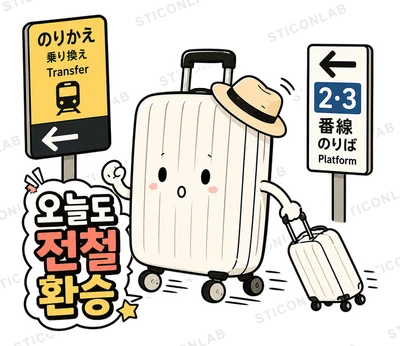
Transfers are hard because of the operators, not the lines
Everyone told me Japanese trains were complicated. What actually confused me wasn't the number of lines. It was that several different companies run them.
There is JR, there is the subway, and there are private railways. On a map it looks like one station with one name. Inside, it is divided by operator. When your transfer crosses from one company to another, you have to exit through the ticket gate and enter again.
If you don't know that, this happens: you stand in front of the gate wondering "if I go out here, do I have to pay again?" and lose thirty seconds. Then you do it ten more times that day.
So, to put it simply:
- Transfer within the same company → you stay inside the gates
- Transfer between companies → you go out and back in. That's normal, not a mistake
- On the signs, the color and letter code are faster to follow than the line name
Also, the transfer time your routing app shows is mostly walking time. Passing through gates and going up and down stairs isn't generously counted. When the transfer crosses operators, I found it calmer to add about five minutes.
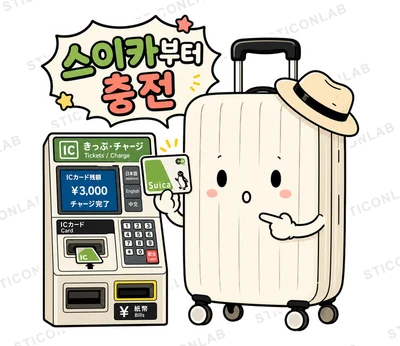
The first thing I did after landing was top up an IC card
The very first thing I did outside the airport was charge a transit card.
An IC card works almost exactly like a transit card back home. Trains and buses, of course — but also convenience stores, vending machines, and coin lockers. It works across operators, so the "several companies" problem I just described disappears the moment you're paying.
A few things worth knowing at the machine:
- There is an English button somewhere on the screen. Press it before anything else
- Machines accept different notes. ¥1,000 notes are almost always fine; some machines won't take larger ones
- You top up in fixed amounts — ¥1,000, ¥2,000, ¥3,000 and so on
I wasn't sure how much to load at first. On a day with a lot of moving around, about ¥3,000 was right. Trains alone wouldn't use it up, but once you're also paying at convenience stores and vending machines, it drains faster than you'd expect.
If the balance runs short, the gate simply won't open. A line forms behind you and you feel rushed, but you just use the fare adjustment machine beside the gate and add the difference. It's not a problem. It happened to me once, on the third morning.
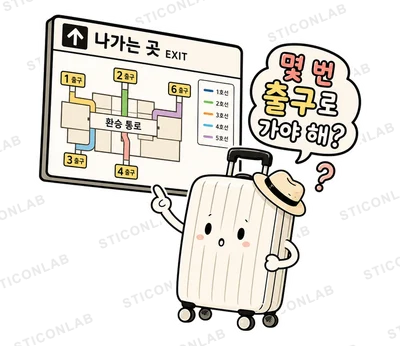
Not knowing the exit number means getting lost above ground
Getting through the ticket gate wasn't the end. It was actually where I lost the most time.
Big stations have dozens of exits. Come up the wrong one and you check your bearings on the street, go back underground, and cross to the other side. That round trip is ten minutes. Longer with luggage.
So I changed one thing in the order I did things: check the exit number before you arrive at the station.
Routing apps usually tell you which numbered exit to take along with the directions. All you have to do is note that number while you're still on the train. Getting off and reading the signs to decide is a completely different experience from getting off and simply following a number you already have.
Signal gets weak in underground passages. For those moments, it helps to take one photo of the station map near the gates.
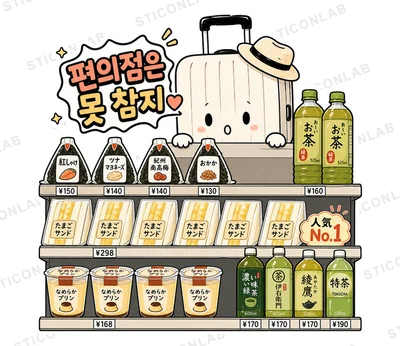
The convenience store wasn't a fallback, it was part of the schedule
In Japan the convenience store wasn't the place I went when I'd missed a meal. It was a place built into the plan.
On mornings with an early start, I bought breakfast the night before. One rice ball and a bottle of tea gets you out of the hotel twenty minutes sooner, because the going out, the choosing, and the paying all disappear from the morning.
I paid with the IC card. Not having to count coins matters more than it sounds — Japan has a lot of coin denominations, and standing at the register staring into your wallet takes a surprising amount of time.
Other things the convenience store solved:
- Anything that needs hot water gets filled right there before you leave
- Many branches have a restroom, which is genuinely useful mid-route
- Umbrellas and charging cables — whatever you forgot, they usually have it
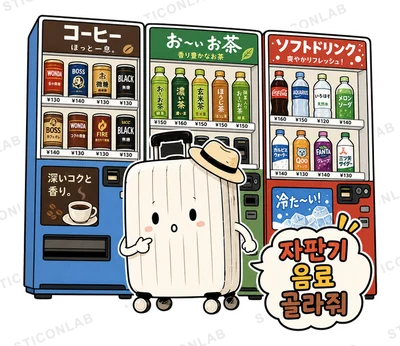
Vending machines were summer stamina management
There is a vending machine on every street. At first I just thought there were a lot of them. Then I walked around in midsummer and realized they were a way of managing energy.
One thing worth knowing: a single machine holds both cold and hot drinks. A blue label under the button means cold, a red one means hot. In winter, pulling out a hot can of coffee and walking with it in your pocket is genuinely nice.
IC cards work here too — there's a marked spot to tap. No digging for coins means less time spent standing still.
Prices are fairly uniform, a little above convenience store prices. They climb as you go deeper into tourist areas, so it's better to grab a bottle near a major station on the way.
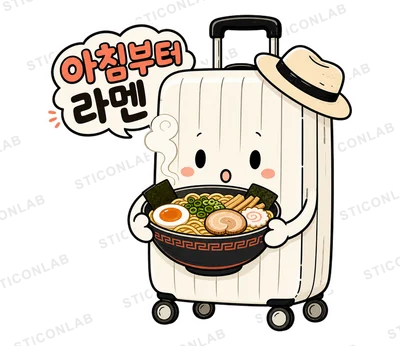
Ramen in the morning makes the whole day quieter
On the last morning I had ramen. I walked in without thinking about it much, and it turned out to be the best decision of the trip.
Not because of the food — because of the timing. There is no line in the morning. By lunch, people are queued up outside the same shop. Nothing in a trip is more wasteful than time spent standing in line, and I skipped it entirely.
Shops open in the morning usually have a ticket machine at the entrance. You buy a ticket from the machine — the one with photos of the menu — then sit down and hand it over. You barely have to speak, so the language pressure is low too.
And a real breakfast lets you push lunch later. You end up moving against the crowds, and the whole day shifts one notch quieter.
What I cut wasn't travel time, it was standing-still time
I didn't move especially fast on this trip. The trains weren't any quicker.
What changed was the time I spent standing still. Thirty seconds hesitating at a gate, a minute reading a screen at the fare machine, ten minutes walking back from the wrong exit. Each one is nothing. Over three days it becomes half a day.
If you're going soon, here is the order that worked:
- Top up an IC card as soon as you land (about ¥3,000)
- Add five minutes to any transfer that crosses operators
- Check the exit number before you get off the train
- Buy tomorrow's breakfast at the convenience store tonight
- Go to the popular places in the morning
Those five alone make the day noticeably calmer.
The stickers in this post are from the Cari's Japan Trip series — transfers, topping up an IC card, finding the exit, the convenience store, vending machines, and morning ramen. They cover the scenes that keep coming up in travel write-ups. Dropping one between paragraphs gives a long post somewhere to breathe.